
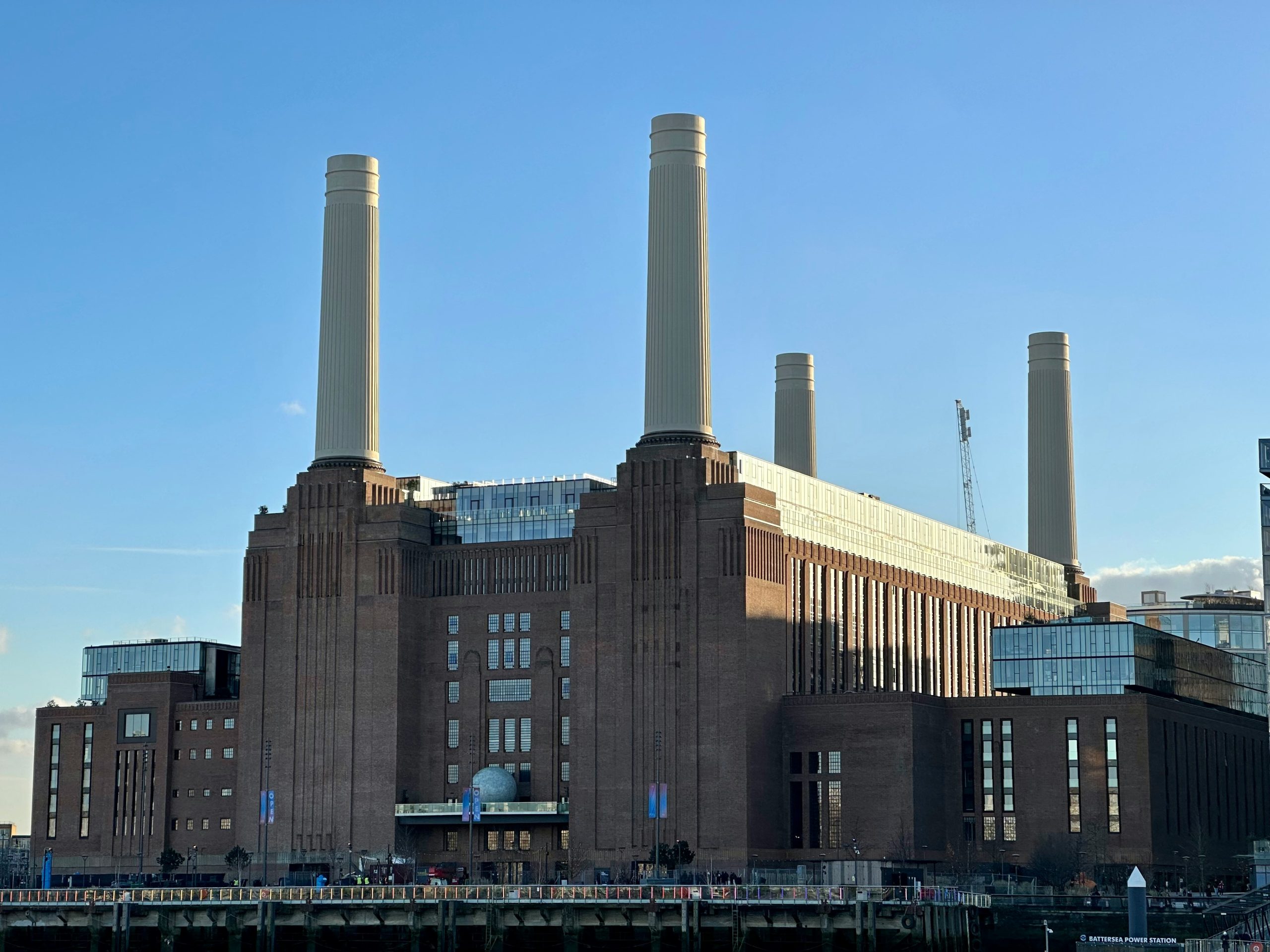
The iconic Battersea Power Station lies on the south bank of the River Thames in London. Its four towering white chimneys that once dominated the London skyline now blend in amongst the newer buildings that now define it.
The power station has played a central role in powering the UK’s capital city, is an iconic cultural reference, and is now representative of the urban regeneration that we are seeing amongst commercial units in the country at the moment.
In this article, we are going to take a look at the story of Battersea Power Station and how it reflects the society in which it stands.
Iconic London Landmark
The Battersea Power Station, with its classic four towers and art deco interior style, was designed by British designer Sir Giles Gilbert Scott – the same person who designed Britain’s famous red telephone boxes, alongside engineer Sir Leonard Pearce, for the LPC (London Power Company).
It was built with the purpose of being a power station, with construction of the first phase (known as Battersea A) starting in 1929, and the second phase – known as Battersea B – was completed in 1955. Construction was paused during the war, however.
The power station was designed in a ‘cathedral style’, giving it the nickname of being a “temple of power” – a high accolade, given the time period in which it was designed. Each of the phases (Battersea A and Battersea B) consisted of the construction of a long boiler house room with a white chimney at each end, and a turbine hall lying adjacent. The entire building is still one of the world’s largest brick buildings, with dimensions of 160m x 170m, and a height of over 50m. Each of the chimneys towers over the building at a height of 103m.
Powering London
At its peak, it is believed that the Battersea Power Station generated about a 5th of London’s electricity, playing a central role in the growth of commercial activity in London and the UK, especially during the last century. During its operation as a power station, large amounts of coal were transported along the Thames into the building, where it was burnt to produce the steam that generated electricity. It is said that when it was working at its best, the building was the most efficient coal-fired power station in the world.
The UK, during the 20th century, was focused on recovering from the war, and commercial businesses relied more and more on electricity, whether it was through manufacturing in factories and warehouses, running offices, or selling goods in retail units. The world was becoming more ‘electronic’ and the Battersea Power Station was helping to power this.
It is reported that during the war, the white plumes from the power station were used for navigation by both the RAF and the German Lufthansa – the reason why many people believe that it was not actually bombed at the time.
The operations at Battersea Power Stations were phased out between 1975 and 1983, as cleaner, better energy generation emerged. But it was not over for the iconic building!
Unused
There was a period after the power station was closed down, where it was left, essentially abandoned, and fell into disrepair. For more than 30 years, the iconic building that had once been a symbol of strength and British industry, and key to London’s commercial success, was left with no purpose.
Over time, the building deteriorated, but it was granted Grade II listed status in 1980 to protect its architectural and historic value – a nod to its cultural importance and the central role it played in London and Britain’s industrial past.
The power station became symbolic at this time for the shedding of the country’s old industrial past, heading into a cleaner, brighter world.
Regeneration and Urbanisation
In 2012, the site of 42 acres was bought by its current owners, with a view that the power station would be developed into a ‘community’ of housing, retail units, cafes and restaurants, office space, an open-air space, and a cultural venue for events.
Once that work had started and some of the first residential properties within the area were sold, work began on extending the London Underground by adding a new station (Battersea Power Station), and a new river bus was launched, carrying passengers into the city.
Today, the Battersea Power Station and its area have been completely redeveloped whilst keeping its iconic (now repaired) building, into a thriving community for locals and visitors alike.
The area has been regenerated to include everything that a community needs, including retail units, office space, restaurants, and housing, as well as a cultural venue. This is indicative of the trend that we are currently seeing of mixed-use units in new builds, conveniently placing residential units and commercial units side-by-side, as well as with the open space that is desired for modern, healthy living – especially in a city. It has kept its industrial character – the famous brick building with white, towering chimneys – whilst being combined with modern architecture and technology.
Battersea Power Station Area, 2026
Today, the Battersea Power Station area is bustling with community and commerce. Through its abundance of retail units, cafes, and restaurants, it has become a popular place to visit for leisure. The space has been used for events such as light shows, conferences, and stunt competitions.
With the additional transport that now connects the area better with the rest of London, it has become easier to visit for locals and tourists alike. Tourists, for example, can travel to the top of one of the chimneys for spectacular views of London.
In addition to this, some of the commercial units in the area now include office space used by the US Embassy and Apple, and a coworking space with meeting rooms.
Here at Boxpod, we are passionate about helping businesses to find their perfect commercial unit to rent.
Here at Boxpod, we are passionate about helping businesses to find their perfect commercial unit to rent.
If you are looking for a commercial unit for your business, have a look at the properties that we have available for rent.
If you are a commercial unit landlord, looking for new tenants, you can list your property with us here!
Take a look at our website and get in touch with us today!